

A new machine costs THB 500,000 and promises to lower costs every year. It sounds worth buying. But before signing a purchase order, we still need to ask: Will it require more working capital? Will it need repairs or replacement parts along the way? What can we sell it for when we stop using it?
A long-term decision starts by listing all cash in and out, from today through the end of the project. Then we can ask whether the future money is worth what we pay now. I use three short questions when reading a proposal: How much cash actually changes, when does it come in or go out, and can we withstand being wrong?
Start with the cash that changes because of the project
Incremental cash flow is money received or paid that differs if we undertake the project instead of doing without it. A new machine might reduce overtime wages actually paid. If it merely frees staff time while salaries stay the same, the recovered time is not yet cash saved. We must explain what the business will do with that time to show its benefit.
Do not start with company-wide sales or the whole accounting profit figure. Look only at what the project changes, including sales it might displace from an existing product. Costs already paid and unrecoverable should not become a reason to keep investing. Existing resources may have an opportunity cost if using them means giving up another job or income stream.
Accounting profit is not the cash received and paid each year. Depreciation is not a cash payment in that year, though its related tax effect may change cash flow. Receivables and inventory may tie up cash before the project collects from customers. Taxes and working capital therefore need to be estimated at the times the money actually moves.
Which cash flows does this example count?
The following example values one project using after-tax cash flows before financing. The discount rate must match that basis. We do not subtract loan interest or principal again from project cash flows. The business must plan financing and debt payments separately so it has enough liquidity.
Put cash in and out on a timeline
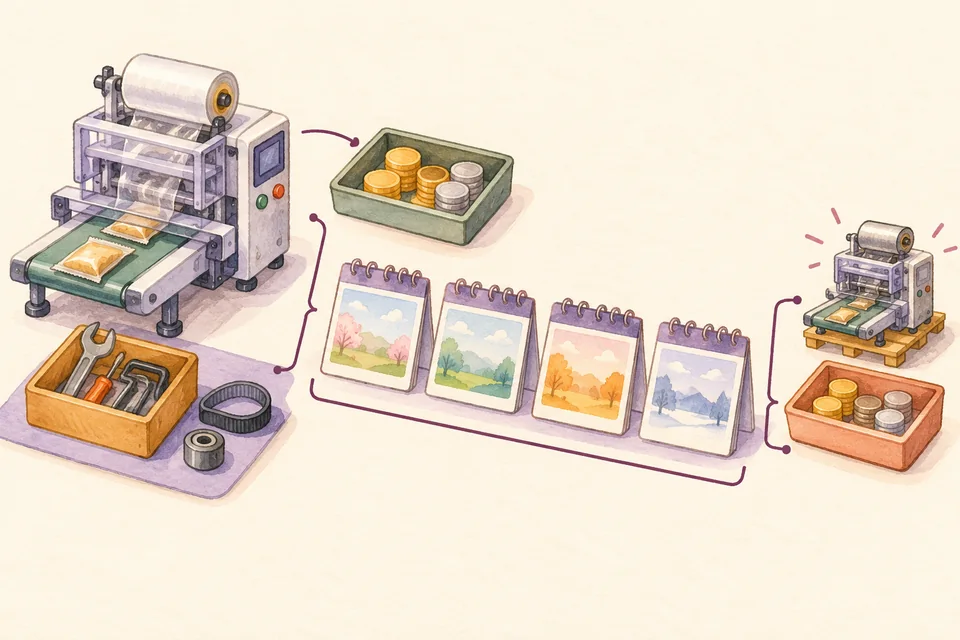
Suppose a business is considering a packaging machine. Buying and installing it costs THB 500,000, and it needs another THB 50,000 in working capital, for a THB 550,000 payment today. The project runs for 4 years. Expected net incremental operating cash flow is THB 160,000 each year after operating expenses and relevant taxes, but before financing items.
At the end of Year 4, suppose the machine sells for a net THB 80,000 after selling costs and relevant taxes, and the full THB 50,000 in working capital returns as cash. Total final-year receipts are then THB 290,000. The returned working capital is not additional profit; it is money previously tied up and now recovered.
| Item | Today | End of each Year 1–3 | End of Year 4 |
|---|---|---|---|
| Buy and install machine | −500,000 | 0 | 0 |
| Add / recover working capital | −50,000 | 0 | +50,000 |
| Net incremental operating cash flow | 0 | +160,000 | +160,000 |
| Net proceeds from selling machine | 0 | 0 | +80,000 |
| Total net cash flow | −550,000 | +160,000 | +290,000 |
- Today · Year 0−THB 550,000Machine and installation: 500,000
Working capital: 50,000 - End of Year 1+THB 160,000Net operating cash flow
- End of Year 2+THB 160,000Net operating cash flow
- End of Year 3+THB 160,000Net operating cash flow
- End of Year 4+THB 290,000Operations: 160,000
Machine sale: 80,000
Working capital recovered: 50,000
Plus means cash in and minus means cash out. The example places every future cash flow at a year-end.
These figures are assumptions for learning, not a forecast for a real company. Future cash flows are stated in nominal Thai baht, and the discount rate uses the same basis. The fixed THB 160,000 each year belongs to this example; real selling prices and costs need not stay fixed. We also do not assume the entire company closes after 4 years. We are defining the boundary of this project only.
Bring money from different years back to today’s value
THB 160,000 today is not equivalent to THB 160,000 received years from now. Today’s money can be used elsewhere, while future money takes time and carries risk. Present value converts each year’s cash flow to a comparable value today before we add or subtract it.
This example uses a 10% annual discount rate solely as a teaching assumption. It is not a standard rate every business should use. In practice, choose a rate suited to the cost of capital, risk, and cash-flow basis. If cash-flow estimates include inflation, the discount rate must use a consistent inflation basis too.
Present value, or PV
PV of cash flow in Year t = net cash flow in Year t ÷ (1 + r)t
t is the number of years from today, and r is the annual discount rate. For example, 10% is 0.10. A THB 160,000 receipt at the end of Year 1 has PV of 160,000 ÷ 1.10 ≈ THB 145,455.
Add the PV of every cash receipt and payment to find net present value, or NPV. Money paid today needs no second discounting, so we use −THB 550,000 directly. For Year 4, we use the full THB 290,000 because the machine sale and working-capital recovery occur along with the final year’s operating cash flow under these assumptions.
NPV ≈ 595,970 − 550,000 = +THB 45,970
Discounted at 10% a year. Bars use the same PV scale. Calculations retain full precision before display rounding to whole baht; the sum uses unrounded values.
NPV is positive by about THB 45,970. This means the expected cash flows have a higher present value than the investment at a 10% discount rate under these assumptions. It is not cash in the account today, any single year’s accounting profit, or the value of the entire business. The positive figure merits further consideration; we still need credible estimates, enough cash, and the ability to carry out the project.
In Excel, you can use this formula:
=NPV(10%,160000,160000,160000,290000)-550000This function discounts equally spaced end-of-period amounts. Put only the Year 1–4 receipts inside it and subtract today’s investment outside. Putting THB 550,000 inside as the first period would shift the investment timing by one period.
A software or systems integration team can use the same approach by asking how a project changes actual receipts or payments, such as added service fees and overtime that will truly fall. If staff hours decline while salaries do not, show the benefit and a plan for using that time separately from cash flow. Do not multiply hours by a wage rate and immediately record the result as cash received.
When do we recover the outlay, and how much value does it create?
Payback tells us how long accumulated receipts take to cover the initial outlay. At the end of Year 3, this example has collected THB 480,000, still short of THB 550,000. It reaches payback when the end-of-Year 4 cash arrives. We say payback occurs at the end of Year 4, not at a fractional year, because the example does not say cash arrives evenly throughout the year.
Undiscounted payback ignores the time value of money and benefits after payback. A project that repays faster does not necessarily create more value. Use it to understand waiting time and pressure on cash alongside NPV, not in place of NPV.
Another number often shown in proposals is the internal rate of return, or IRR: the discount rate at which NPV equals zero. The base-case cash flows give an IRR of about 13.45% a year, above the assumed 10% discount rate and consistent with the positive NPV. But 13.45% comes from expected cash flows; it does not guarantee that the actual return will match it.
If projects cannot both be undertaken, do not choose solely by the higher IRR. Investment size and cash-flow timing may differ. Compare NPV on a suitable common basis as well. Different initial investment amounts do not automatically make NPV incomparable. If project lives differ or the budget is constrained, first choose a comparison method suited to that decision.
Lower the expected cash flow and see whether the decision still holds
A more useful question than recalculating to get the same answer is: What if annual operating cash flow is only THB 140,000? Keep the initial outlay, machine-sale proceeds, working-capital recovery, and discount rate unchanged. This tests one assumption; it does not forecast which case will happen or assign probabilities.
| Item | Base case | Lower operating cash flow |
|---|---|---|
| Investment today | 550,000 | 550,000 |
| Annual net operating cash flow | 160,000 | 140,000 |
| Total receipts at end of Year 4 | 290,000 | 270,000 |
| NPV at a 10% discount rate | +45,970 | −17,427 |
| Undiscounted payback, using year-end receipts | End of Year 4 | End of Year 4 |
Base case
Annual net operating cash flow
THB 160,000
NPV at a 10% discount rate
+THB 45,970
Payback at the end of Year 4
Lower operating cash flow
Annual net operating cash flow
THB 140,000
NPV at a 10% discount rate
−THB 17,427
Payback at the end of Year 4
Knowing only the payback year is insufficient. Both are hypothetical. Initial outlay, machine-sale proceeds, working-capital recovery, and discount rate remain the same.
The THB 160,000 annual cash-flow assumption therefore deserves scrutiny. How well supported is the expected workload? Does the predicted cost reduction actually lower payments, or merely make work faster? Are all machine maintenance costs included?
Check the machine’s sale value and working capital separately. Can the machine sell for the hoped-for price? Will receivables be collected in full, and how much cash can remaining inventory produce? Assuming full recovery merely to make the project look attractive can lead to a bad decision even when the arithmetic is correct. In practice, also test slower receipts, higher costs, and a lower sale price.
Before approval, know what to prove and who will follow up
Some projects do not directly increase sales, such as replacing equipment needed to maintain the current service level. If alternatives provide comparable service, quality, safety, and risk, we can compare the present value of their costs over an appropriate period and consider the lower-cost option. Confirm that comparability first; a cheaper purchase price alone may not be enough.
For a project that looks worthwhile on paper, I would use the following questions to examine the proposal before approval. We need not write a long report every time, but the people funding and operating the work should be able to give consistent answers.
- Compared with what? What happens if we do nothing? Could we repair the old machine, lease, test first, or use the funds for another project?
- Where does each cash flow come from? How do quotes, workload, costs, and collection terms support the figures? Are tax, working capital, and exit costs included?
- When must we pay, and how long can we wait to collect? Check the cash timeline against available funds. A positive-NPV project can still create a cash shortfall along the way.
- Which assumptions change the answer? Test a reasonable downside case, then decide whether to invest fully, run a smaller trial, or wait for more evidence.
- Who owns the result after approval? Name the operator, approved budget, review points, and evidence for comparing actual results with estimates. Who proposes a change or stop if the gap is large?
Approval should not end with a spreadsheet whose arithmetic is right. Follow up on whether cash and work match the forecast. Where a board or separate approver reviews a proposal, they should be able to challenge its assumptions. A smaller business can use the same principle by separating proposal, review, and approval roles according to the work’s size and risk.
If a project is on your desk, start with one sheet of paper. Put today’s required cash on the left and list cash in and out for each year through the project’s end. For any blank, name who will find the missing information. Knowing what we do not yet know helps more than adjusting figures until they give the answer we want.
Further reading
The packaging machine and all figures are hypothetical, created to explain investment appraisal. The following sources offer more detail:
- CFA Institute: Capital Investments and Capital Allocation on evaluating projects and allocating capital
- ACCA: Investment appraisal on incremental cash, tax, working capital, and timing
- OpenStax: Choosing between Projects on comparing investment choices
- Microsoft: NPV function on keeping today’s investment outside the NPV function