

Suppose AI has helped finish a feature that notifies people about overdue tasks. Before customers use it, the team still has to answer: Who checks who may receive each message? How will we know it is not sent twice? Who stops the job if something goes wrong? Finished code still needs review and someone responsible for it after release.
Platform engineering organizes the tools and steps a team repeatedly needs to test and release software, making them easier to use together. When AI drafts code or configuration, we still decide the boundaries, permissions, evidence, and who will operate the system afterward.
This article uses a fictional software and systems integration team to examine when an internal platform is worth investing in, how small to start, and how to measure value. It does not assume every company needs a new team or the same set of tools.
Platform engineering starts with the work its users need to do
Platform engineering designs and operates shared tools, processes, and services for internal teams so people can get work done themselves while knowing the rules and who maintains the service. The result might be a project starter template, a test and release process, a secrets service, documentation, or a connected way to request resources. It need not begin with a central dashboard.
The CNCF Platforms White Paper treats a platform as a product for internal users. That suggests starting with the work that frustrates them and listening to their experience over time. In our fictional team, users want to start a project and know how to test and release it without asking the same person every time. Knowing which work to help them with guides what the team should build first.
DevOps emphasizes how development and operations work together. SRE applies engineering to service reliability, including monitoring and incident response. A team can use platform tools and processes to support both while each service still needs an owner. The introduction to Google’s Site Reliability Engineering book explains the relationship between DevOps and SRE; a team need not adopt Google’s entire organizational structure.
A developer portal is one entry point to a platform. Backstage is a framework for building one. But a service catalog and deploy button do not prove that tests passed, access rights are correct, or someone will respond to incidents. We must also check whether the systems those buttons call actually work as intended.
What AI changes and what still needs a decision
DORA’s platform engineering page connects its 2025 findings to the view that AI may amplify an organization’s existing strengths and bottlenecks. We should therefore ask whether testing, review, and release keep pace with faster code creation. The page also cites 2024 research on benefits and limitations for delivery and stability. These findings do not guarantee that building a platform will produce the same result for every team.
By design, an AI system proposing changes through an API or commands should have an auditable identity, only the access it needs, and resource limits suited to the job, such as a spending or runtime cap. Telling it in a prompt not to touch production is not access control. The systems behind the prompt must enforce the rules and retain evidence of who or what requested each action.
The GitHub Copilot cloud agent documentation offers a product-specific example of branch boundaries, human review, and activity logs. Other teams must inspect their own tools and settings and match approval to impact. A small documentation fix need not go through the same process as a change to access rights or customer data structures.
We should also distinguish using AI to build a platform from building a platform that serves AI work. A system that calls models or processes data through them may need additional answer-quality tests, data access controls, and usage budgets. Adding a coding assistant does not mean every team needs a GPU or its own model-serving system.
Follow the work before and after a feature goes live
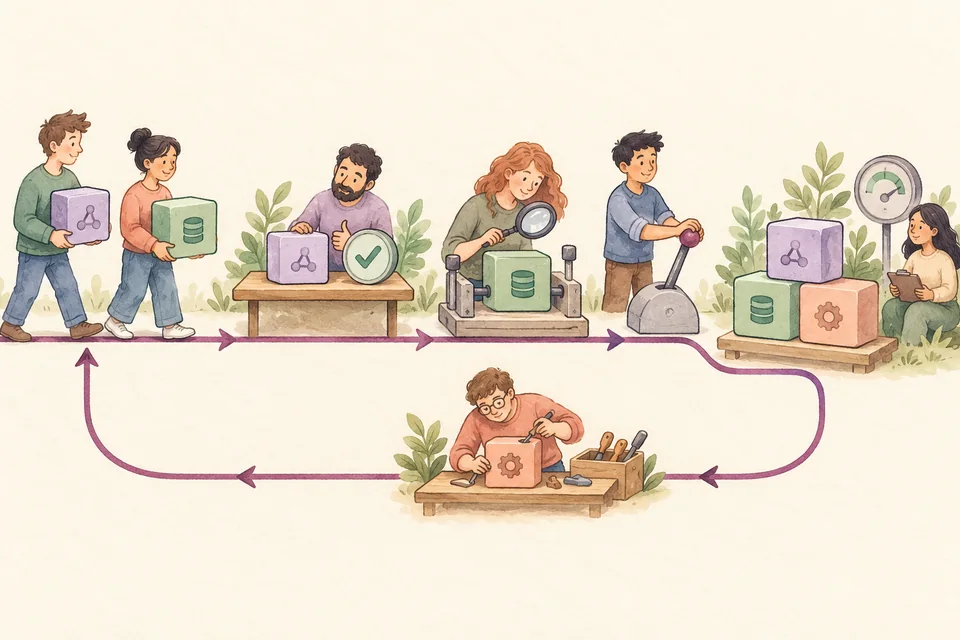
Return to the overdue-task notification feature. AI can help draft code and tests. The team first decides who should receive a message, what information may be disclosed, and how to avoid sending the same message twice when a job is retried. This question about retries matters for work that can cause a duplicate effect; it does not mean every command has the same solution.
A project template may already provide code review and tests using test data. The developer adds cases specific to the feature. Test results should tell the team what was checked, what remains unchecked, and who owns any exception, rather than showing only a green status with no detail.
From code change to operation after release
- Propose a changeA person or AI works within defined permissions
- Test and retain evidenceCheck shared steps and cases specific to the feature
- Choose review by riskMatch the check and reviewer to the impact
- ReleaseKnow which version runs where and how to stop it
- Monitor and respondDetect problems and know who will fix them
The team uses tests and post-release problems to improve templates, rules, and documentation
Before release, the team should know which signals to watch, such as failed or duplicate messages, and who can stop the job. A risky change might start within a limited scope under a tested plan. A stop mechanism also needs a person who knows when to use it.
Rolling back code cannot unsend an email, nor does it automatically reverse every data change. Database changes need a recovery and verification plan suited to the change. The platform team owns shared tools, processes, and services; the feature owner still has to understand the behavior of what was released.
Start with the team’s existing tools and name their owners
Our fictional team could start with its existing CI/CD service to review, test, and release work, managed cloud services, a project template, and an incident runbook. Name who updates the template, who helps its users, and who decides when a project needs an exception to the standard process. Together these can form a reusable service even without a portal.
The CNCF Platform Engineering Maturity Model recognizes approaches that begin with documentation and external services, and notes that higher levels require more money and staff time. There is no reason to chase a level just to sound more complete. If a template and documentation first remove repeated work in this case, there is no need to add Kubernetes or a full-time separate team merely to call it a platform.
The team also needs a way to receive suggestions and exceptions. If the standard process is so hard to use that every project waits for an intermediary, it may have moved the queue to one place. Ownership includes listening to users, improving what does not fit, and retiring tools or services no one uses.
Count build time and operating cost when judging value
Suppose the team spends 120 hours building and testing a shared process during the first 3 months. It then uses the process for 9 months of the first year. Across the team, it expects to eliminate 18 hours of repeated work per month, while adding 8 hours of maintenance and THB 2,000 of service fees per month of use. Every hour counts only time people actually spend doing the work, whether building, repeating tasks, or maintaining it. These figures are assumptions, not market wages or service prices.
Assume an internal value of THB 800 per hour to compare the value of time recovered with the time and money spent. Do not multiply all machine or queue waiting time by an hourly labor rate. Count added service fees only for the 9 months of first-year use in this example. Existing service fees that do not change are not added again as incremental costs.
| Item | Year 1 | Following year |
|---|---|---|
| Initial build time | 120 hours | 0 hours |
| Time recovered from repeated work | 18 × 9 = 162 hours | 18 × 12 = 216 hours |
| Additional maintenance time | 8 × 9 = 72 hours | 8 × 12 = 96 hours |
| Repeated work avoided, less build and maintenance time | −30 hours | +120 hours |
| Value of recovered time | THB 129,600 | THB 172,800 |
| Value of build and maintenance time | THB 153,600 | THB 76,800 |
| Additional service fees | THB 18,000 | THB 24,000 |
| Value of time saved, less build time, maintenance time, and service fees | −THB 42,000 | +THB 72,000 |
Year 1: build for 3 months, use for 9
−THB 42,000
Recovered time does not yet offset assumed build time, maintenance, and service fees
Following year: use for 12 months
+THB 72,000
Possible only if use continues and repeated work falls as assumed
Year 1 is (162 − 120 − 72) × 800 − 18,000 = −THB 42,000. The following year is (216 − 96) × 800 − 24,000 = +THB 72,000. The positive value in the following year depends on having useful work for the recovered time, continued platform use, and maintenance within the assumed amount. It cannot yet be called cash savings or additional revenue.
The model does not yet price incidents, risk, delays to other features, or growing demand. The 120 hours spent building are already counted, so we should not add the opportunity cost of those same hours again. Separate adverse effects still need consideration when supported by evidence. A platform’s ability to handle more work is a different benefit from reducing cash cost; one cannot stand in for the other.
Choose whether to invest, run a trial, or wait
If the team repeatedly sees the same work, knows which teams will use a shared solution, and has someone who will maintain it, those facts can guide the investment. If it still cannot say which work will shrink, a trial process for one service or project can reveal what needs fixing without first building a large central system.
Before a trial, record what users do, how much hands-on time it takes, how often they ask for help, and where work fails. Afterward, compare similar work. Check whether the burden moved to the platform team. Read any speed gain alongside change quality and time to respond to problems. No universal team-size threshold makes a platform pay off for every business.
Waiting to build a new platform can be reasonable if there is no service owner, no clear repeated work to reduce, or an existing managed service solves enough of the problem. The first move might be an ownership list, missing documentation, or an incident drill. Waiting should include a trigger for revisiting the decision, not leave the same problem unattended.
Measure what the team can do independently and where recovered time goes
Do not count only templates or portal visitors. Ask whether users finish work on their own, can understand and recover from mistakes, how much maintenance rises, and what the recovered time is used for. Measures should connect to the original problem. The amount of AI-generated code is not a substitute for delivery outcomes.
Before starting a platform engineering project, I would have the team pick one task several people repeat. Name its users and owner, the problem to solve, and the time and money needed to maintain the solution. Then try it and see whether the work actually gets easier. If we cannot yet say what work it helps, another tool may not be our first move.
Further reading and the example’s limits
The linked primary sources include CNCF on platforms and maturity, DORA on delivery findings, Google SRE on reliability responsibility, and Backstage and GitHub documentation for product-specific examples. The systems integration team, workflow, and value calculations are hypothetical cases created for this article. Applying them requires checking the facts and tools of the actual team.