
Say a batch of fresh durian, lot PK-204, is held for inspection at the Chinese border. The officer gives the exporter a lot number and a shipment reference. The export team needs to know which orchards supplied the fruit, which incoming lots the packhouse used, and whether any of that fruit is in another container. If the receiving and packing records share only an orchard name, the team may be able to say little more than “we think it came from this orchard.”
Start with the lot number on the physical goods. Follow it through the export shipment, the packed lot, and the incoming lots back to their orchards. Then trace those incoming lots forward to see which other packed lots contain fruit from the same batch and where those goods are now.
How the Thailand–China durian protocol relates to traceability
On November 13, 2026, the Thai government reported that Thailand and China signed an update to their phytosanitary protocol for Thai fresh durian exports to China. The announcement identified work on managing risks from quarantine pests, improving traceability from the orchard to the packhouse, and developing a food safety testing plan. Thai government announcement, November 13, 2026 (in Thai)
The announcement summarizes the signing. For requirements that apply to a specific shipment, consult the protocol and implementing notices from the responsible authorities. The border hold, reference numbers, and records in this article are fictional examples for packhouses and exporters that choose to connect their records in an ERP system.
Start with the export records and trace back to the orchards
In this example, the export team uses reference EXP-042 to open the shipment record and compares its container number and carton markings with the information supplied by the border inspectors. The record confirms that the container holds packed lot PK-204. The packhouse record for PK-204 shows that it used fruit from incoming lots IN-071 and IN-072. The two receiving records lead back to Orchard A and Orchard B, respectively.
The packhouse name on the export paperwork tells the team where to request the packing record. That record tells them which orchards contributed fruit. If the packhouse mixed fruit from two orchards and kept records at the packing-run level, the evidence identifies both orchards as sources for the run. Identifying the source of a particular carton requires records at that level of detail.
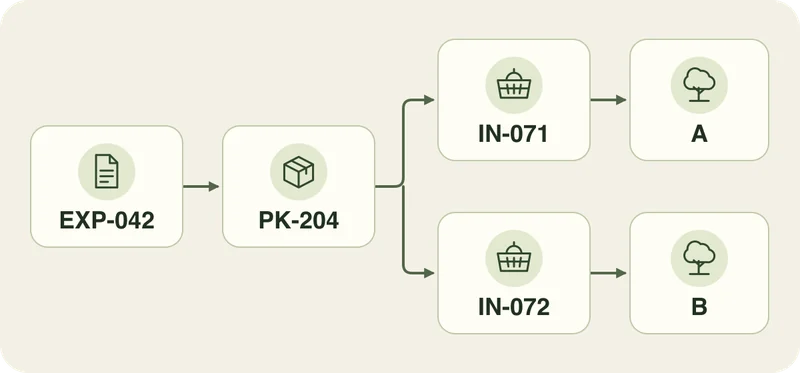
Follow each incoming lot to see where else the fruit went
Say the packhouse received 1,000 kg of IN-071. It used 600 kg in PK-204 and 350 kg in PK-205, and discarded 50 kg during sorting. Another 400 kg from IN-072 went into PK-204. The quantities account for all of IN-071 and show how fruit from both orchards ended up in PK-204.
While investigating the border hold, the quality team checks where PK-205 is now. In this example it’s still waiting to go out on EXP-043. The team can consider placing that lot on hold pending investigation, based on the reason given and the company’s procedures. For goods that have already left the warehouse, the delivery records identify the recipients and quantities so the team can follow up. A shared incoming lot gives the team a reason to investigate further. Decisions about release and border action depend on the evidence and the responsible parties in each case.
What each team needs to record
I’d start wherever goods or paperwork change hands. At each point, give someone responsibility for recording the reference that leads to the next record, along with the quantities actually handled.
| Step | Records for tracing the lot |
|---|---|
| Receive fruit from the orchard | Incoming lot ID, orchard or plot ID from the source records, receipt date, quantity, and receiving document. |
| Sort and pack | Packing run and packed lot ID, every incoming lot used, quantity used from each lot, quantities packed, discarded or left over, and relevant quality records. |
| Store and ship | Storage location, hold or release status, export shipment reference, container number, all lots and quantities loaded, recipient, and delivery documents. |
Odoo Inventory supports lot numbers on receipts and deliveries, and its Traceability report shows a lot’s stock movements. A packhouse that records packing runs in Odoo Manufacturing can also assign lots to the finished goods, as described in Odoo’s documentation. Each business needs to decide how to link export paperwork to lots loaded into a container, record actual quantities when lots split or merge, and approve holds and releases. Odoo 19 documentation on lot numbers and traceability · Odoo 19 documentation on manufacturing with lots
Run a traceability drill before there’s a hold
Pick a completed shipment. Ask someone who didn’t prepare the records to start with the shipment reference and a carton label. Time how long it takes to find the receiving records for every source orchard. Then pick one incoming lot and trace which quantities are still in storage, which were discarded, and which shipments took the rest. Check the totals against the underlying records and note where someone had to make a call to fill a gap. Fix that record before the next drill.