

We have ended the office lease and intend to try working from home (WFH) full time for three or six months to see whether it suits the team. There are no trial results yet from which to say it is working well or poorly. The next step is to assign owners and methods for each kind of work, then collect evidence for the decision.
I propose starting with a three-month trial, reviewing actual work, and extending it another three months to a total of six if we need more evidence or a chance to adjust a process. This is a proposed framework; it does not mean we have agreed on the duration or start date. Legal, customer, or important data problems need attention immediately, not at a review date.
In What Is an Office For When the Team Works from Home Full Time? I separated receiving documents, keeping originals, and meeting people from giving every team member a permanent desk. Now that the lease has ended, the questions are how to handle those jobs and how to decide whether full-time WFH should be a long-term way of working.
Ending the lease does not mean the move is complete, document services are in place, or registration and tax steps have been cleared. We must check their actual status and not plan on the assumption that the old space remains available. The arrangements below are proposals for the trial, not a report that they have all been implemented.
This framework suits software, consulting, and systems integration teams whose work can be delivered remotely. Shops, factories, warehouses, and premises required by a specific license still need locations for their functions. We also need to say exactly whom “100% WFH” covers. If a job requires in-person meetings or someone works on site, explain that condition plainly.
Agree first on what the trial will measure
I would not decide by counting who is online or simply by feeling that home is more convenient. The questions are whether we deliver to customers as agreed, whether the team can work together, and whether work involving physical items has an owner through completion.
Before the trial, agree on its start date, review periods, and goals for each kind of work, with existing contractual and legal deadlines as the baseline. Use comparable pre-WFH data if it exists. If it does not, record that limit and start collecting evidence during the trial. Do not claim improvement against a baseline we do not have.
| Area | Evidence for discussion | Signal that needs action |
|---|---|---|
| Delivery and quality | Due dates, work accepted by recipients, rework and its causes, separating remote-work problems from other causes | Late or repeated work caused by coordination gaps, with no owner addressing them |
| Customer contact | Agreed response times, complaints, attempts to reach the responsible person, and follow-up outcomes | Customers must chase several people, or urgent matters sit because the contact channel is unclear |
| Documents and originals | Case register, response or filing deadlines, proof of delivery to the recipient, and results of retrieving originals | No case owner, files cannot be retrieved in time, or a case is closed without proof of receipt |
| Team load and collaboration | Time spent on core work and administration, work outside agreed hours, help for new people, and what team members say is blocking them or making them feel isolated | Work piles up on one person, after-hours contact prevents rest, or someone needing help has no backup |
| Information and continuity | Access reviews, recovery tests, backup coverage, and logs of unusual events and responses | Excess access, failed recovery, or an important risk with no owner. An absence of incident reports alone does not prove safety |
| Total cost | Document receiving and storage, transport, meeting rooms, equipment, agreed team expenses, and people’s time, separating one-time from recurring costs | Office savings shift into services or team time until the model no longer pays off, with no way to adjust it |
Collect only enough information to make the decision. Focus on delivered work, acceptance, and conversations with the people doing it, not all-day cameras or mouse-movement monitoring as a stand-in for results. Agree on time and quality goals for the actual work; one number will not fit every team.
For work that still needs physical premises, I propose arranging a space that meets the applicable requirements, a vetted document-receiving and original-storage service, an internal owner with a backup, and a meeting room when people need to meet. Someone’s home may be an option if there is a right to use it and the conditions are met, but privacy and backup coverage matter. A mailbox service or coworking membership alone may not cover these needs.
If we use an outside service, the provider still needs people to receive and care for documents on site. We have to pay for the agreed scope and backup. Count our own administrative time too; do not always put the burden on whoever lives closest. Before claiming a saving, include any actual costs still tied to ending the lease or moving, and compare total costs using service quotes and time recorded by the team.

Check the premises and open tasks immediately after ending the lease
Ending a lease does not end our duties regarding premises and documents. The registered address, tax premises, mail-receiving point, and location of accounting records may each have different requirements. Check which location is currently used, our right to use it, and who is responsible. Buying an envelope-receiving package does not prove every requirement is met.
For VAT, check the actual establishment, evidence of the right to use the premises, and the business sign. Revenue Department Notification No. 159 on online registration Clause 6(4) says a registration certificate is not issued where another party’s law or accounting office is used as the place of business, subject to specific exceptions in the notice. We should not assume that using an accountant’s address automatically qualifies.
Revenue Department Notification No. 256, effective September 1, 2025 also stresses an actual move. If no goods are sold or services provided at the new establishment, or there is no real new establishment, it is treated as though no move occurred. Changing the address with the Department of Business Development alone therefore does not settle VAT. Check whether company activity at the new location meets the requirements. A provider’s employee receiving envelopes does not itself confirm that the company qualifies.
The immediate task is for the accounting and tax owners to check the actual site, use rights, company activity, the move date that occurred or is planned, and the status of notices to agencies. A VAT establishment move requires notice at least 15 days in advance under Revenue Code Section 85/8. Review this with the local Revenue Office, along with steps for the Department of Business Development and other relevant agencies. For anything late or unclear, seek advice on the specific facts now, rather than wait for the trial to end or backdate a filing. A service vendor’s assurance is something to verify, not a tax conclusion.
| What must be ready | Evidence the owner must provide | If it is not ready |
|---|---|---|
| Premises and change notices | Actual right to use the site, sign and inspection conditions, registration, tax, bank, license, and counterparty notices, with a person confirming each | Have the owner contact the relevant people and agencies immediately and arrange a genuinely usable site. Do not assume we can still use the old one because we once rented it |
| Document receiving and storage | A contract specifying service hours, who may receive and open envelopes, storage, retrieval, forwarding, confidentiality, backup coverage, and file removal when service ends | Arrange an authorized recipient and immediate storage or retrieval route for each document type. Do not leave files with no owner |
| Documents and customer work | List of items still requiring paper, customer terms, retention periods, and a signing route accepted by the case owner and document recipient | Keep a paper process for matters that require it and verify delivery to an authorized person by the deadline |
| People, systems, and backup coverage | Primary and backup names, system rights, working-time agreements, administration budget, and the result of a test with the primary person absent | Name the owner and backup, grant needed access, and fix work that cannot yet be handed over |

Accounting records also need a storage-location check separate from the envelope-receiving address. Accounting Act B.E. 2543 (2000), Section 13 sets the storage location and a route to seek permission to store them elsewhere. The retention clocks and conditions for accounts and VAT documents differ. I would ask the accountant to make a schedule by document type and check permission and tax rules before sending files away. Scanning does not authorize destroying every kind of original. See also ETDA on originals and document conversion
Assign one internal coordinator and a backup who can take over
I would assign an internal document coordinator to maintain the case register, work with the envelope recipient, and follow each matter to completion. That person need not read or approve every document, but must know who holds each open item. The case owner, such as the customer lead or accountant, remains responsible for its content and deadline. Signing authority remains with whoever the company has authorized.
The backup needs the necessary access and practice doing the work. When the primary person is on leave or does not respond within the agreed time, the backup should take over under the rota without asking the person who is off duty for a password. In a small team, one name may cover several roles, but write down who helps when times collide and who checks important approvals.
I would use one central intake channel, such as a company email tied to a case register. Give each matter one reference number, and record the sender, receipt time, owner, deadline, status, location of the original, and a restricted-access file link. Discussion can happen in chat, but instructions and the latest status must be recorded in that case. Otherwise, tracking depends on who is still in the chat group.
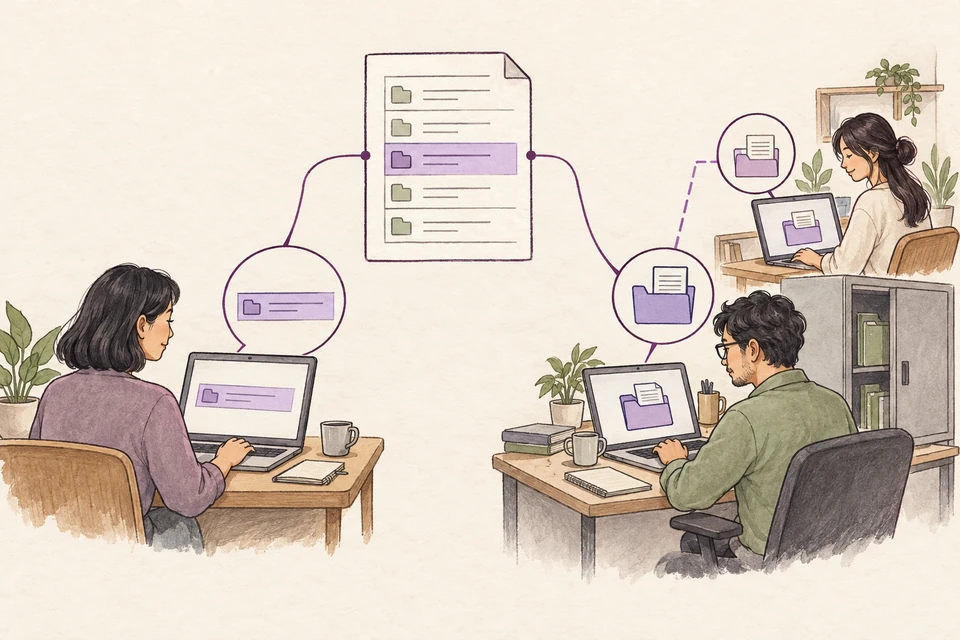
Set intake hours to match working hours. My proposed starting target is receiving matters on business days from 9:00 a.m. to 5:00 p.m., logging incoming envelopes and notifying the team within two business hours, then clearing the pending list before day’s end. These figures are management targets that need a staffing test, not legal response times or a promise that every company can meet them. Legal deadlines, official letters, and suspected irregularities must be escalated immediately under the rules for their type, without waiting two hours.
Service hours do not change the actual date of receipt or a legal deadline. A time-sensitive letter must reach an authorized reviewer immediately by the agreed route, including after hours. Check which types of letter the service provider is authorized to receive. If neither the case owner nor backup acknowledges it, the recipient or document coordinator must escalate to a named manager rather than leave it pending after a system notification.
After hours, arrange secure envelope storage and a clear time for handoff. If the business needs emergency cover, agree separately on the people, shifts, and costs; do not turn a personal phone into an all-day intake desk. Section 23/1 of the Labor Protection Act requires an off-premises work agreement in writing or accessible, reproducible electronic data with unchanged meaning, and gives the employee a right to refuse contact after normal hours or the assigned work is done unless prior written consent is given under the conditions. Read the Labor Protection Act (No. 8) B.E. 2566 (2023) and make the agreement fit the actual work.
Receiving, reviewing, and returning a contract when the coordinator is away
Here is a hypothetical scenario. A customer’s paper contract reaches the document point on a Tuesday morning. The company must review, sign, and return it. The document coordinator is on leave that day and the authorized signatory works from home. I would use the same standard operating procedure (SOP) as on a fully staffed day, with the agreed backup taking over.
| Stage | Owner | Action and evidence to retain | Exception to escalate |
|---|---|---|---|
| Receive the envelope | Provider’s envelope recipient | Record receipt time, sender, tracking number, and envelope condition. Enter it through central intake to create a reference number, store it in the controlled location, and notify the scheduled backup | For an envelope addressed to a named individual or marked not to open, record the outside and forward it to an authorized person. Use specific rules for wrong-company mail, damaged envelopes, or official letters |
| Take responsibility for the case | Internal backup | Acknowledge the work under the same case number, identify the contract owner, and confirm the real deadline. Check whether review, signature, and transport can meet it. Mark the case received | If the owner cannot be found or the deadline cannot be met, have a manager decide immediately. Do not promise the customer on behalf of an authorized signatory |
| Open and copy | Person authorized to open and scan | Check pages and attachments, scan legibly and completely, store in a restricted location, send the link to the case owner, and record where the original sits | If no one has authority to open it, or its confidentiality exceeds the purchased service, forward the sealed envelope to an authorized person. Do not fix this by posting images in a group chat |
| Review and approve | Contract owner and approver | Check the text, revision, signing authority, and method accepted by the counterparty. Tie the approved version and signing instruction to the case number. Mark it awaiting signature | For mismatched text, missing attachments, or absent approval, pause signing and request the correct version |
| Sign and return | Authorized signatory, coordinated by the backup | For paper, send the approved version to the signatory by a trackable method. Check copy count, signatures, and attachments before return. Record sender, recipient, tracking number, and a copy of the signed version | If the signatory is unavailable, use only a valid existing delegation or agree on a new deadline. Administration must not sign without authority |
| Close and retain | Backup and original-document custodian | Obtain proof the customer received it. Record which original the customer holds and which must return for storage. Confirm receipt into storage, log the retention deadline and owner, then close the case | With no proof of receipt or no return of the company’s copy, leave it pending. Shipping the parcel alone does not close the case |
I propose these contract statuses: received, awaiting owner, review and approval, awaiting signature, returned, awaiting confirmation, and closed. At each handoff, the next person must acknowledge it. A message sent into silence does not mean the work has been taken over.
If the customer accepts electronic documents and that method meets the applicable conditions, we can shorten the paper-delivery steps. We must still verify the signatory, intent, document version, and auditable signing evidence. I would list in advance which document types use which methods, who confirms them, and what the recipient needs. The sender’s convenience alone should not decide.
ETDA explains trustworthy electronic signatures and evidence. Apply the conditions for each document and recipient. Retain the original signed file and supporting evidence, rather than relying only on a printout or screenshot.

Give other recurring work an owner and a shared method too
A contract is only one case. Outgoing letters, tax deadlines, computers, and customer meetings all need owners. If we can receive envelopes but a new employee’s computer has not arrived, or nobody checks filing deadlines, the organization still gets stuck.
| Work and owner | What the owner must do | Evidence and escalation |
|---|---|---|
| Outgoing letters and tax deadlines Accountant or case owner | Enter legal or contractual deadlines in a shared calendar, set advance reminders, allow time for approval and shipping, and confirm the recipient’s required delivery channel | Keep the approved version and proof of filing or receipt. Sending an email does not necessarily count as a valid filing. If approval is stuck near a deadline, have a manager decide |
| Parcels and physical equipment Asset custodian | Notify the recipient in advance, check whether the service point accepts that type of item, and record sender, recipient, model or serial number, condition, and handoff. Ship directly to an employee when appropriate | Have the recipient confirm the item and its condition. Valuable or oversized goods, or devices containing data beyond the service scope, need separate shipping, not a pile beside the mail |
| Joining and leaving People and systems owners | Prepare role-based devices and accounts, enable multifactor authentication, and test recovery through the company. On departure, revoke access and sessions from the old device, then recover equipment against a checklist | Keep a handoff register and a confirming person. Shared passwords are not a backup plan. Report a lost device immediately to IT or security to suspend access, remotely lock it where possible, and assess exposed data |
| Open cases and administrative capacity Document coordinator and manager | Review open items before day’s end, arrange backup for planned leave, and track envelope volume, follow-up time, and urgent interruptions | Each item needs a named next owner and deadline. If the backup cannot cope, add capacity or service rather than extend working hours without agreement |

Tracking data should show only what is needed to manage work. A coordinator needs to know who has a file without necessarily reading full salary or customer details. Contracts with document recipients and file custodians should specify reading rights, confidentiality, subcontracting, incident reporting, and return or deletion of data under the relevant duties.
If a provider processes personal data on company instructions, check duties and agreements under Personal Data Protection Act B.E. 2562 (2019), Section 40 as well. Outsourcing does not erase the company’s responsibilities. Data minimization, restricted access, and handoff review belong in the service purchase from the start.
Remote deliverables still need an output, deadline, reviewer, and completion criteria. Keep files and decisions in company-controlled space with role-based access. Devices need the prescribed protection and updates. IT must back up important data and test recovery; putting a file in the cloud does not guarantee it can be recovered in every case. I propose periodic access reviews and recovery tests based on risk and customer commitments. See the NIST/NCCoE guide on preparing and testing backups
Book a room when meeting in person serves the work
I would not require everyone to meet monthly just to prove we are still a team. We could review work together, perhaps once a month, with the meeting owner saying what the session should accomplish. Book a private room to resolve a design issue that remote discussion has not clarified, onboard someone, or plan collaborative work. If the purpose is only a progress report, people can read it and discuss it remotely.
Before booking, check travel, room access, costs the company will cover, confidentiality, and the audio and video experience for remote participants. If attendance is a work requirement, state the frequency, scheduling method, and what happens when someone cannot attend in the agreement. Do not call the role remote and then add an unannounced room-attendance rule.
On the day, give one person ownership of the meeting. Check participant access and shared files, use approved devices and networks, and do not leave accounts signed in on shared equipment. Afterward, collect papers, remove data from room devices as appropriate, sign out, and record decisions, owners, and deadlines in the company system.

Handle exceptions immediately, not at the end of the trial
In the hypothetical contract case, the backup can cover the absent coordinator because access and the rota were arranged beforehand. If every absence still requires calling the case owner, the backup plan does not work. Unusual events need a direct reporting route to a manager and data owner; a contractor should not make a silent decision alone.
| When this happens | First actions and owner | Condition for resuming |
|---|---|---|
| System unavailable or owner absent | Backup takes over; IT opens an approved secondary contact channel, makes only the necessary temporary records, and prioritizes work by actual deadlines | Verify rights and data before restoring the main register. Do not send confidential files to personal accounts to bypass the system |
| Original lost, damaged, or misdelivered | Document coordinator stops further forwarding, preserves handoff evidence, notifies the case owner and manager, assesses deadlines, and seeks relevant advice | Confirm the usable version and remedy with the recipient. Do not create a new document made to look like the old original |
| Wrong person opens it or data leaks | Discoverer alerts the data owner immediately, limits access where possible, preserves facts and evidence, and assesses affected people and legal notification duties | Owner confirms containment and approves a safer delivery method. Do not wait for the monthly meeting to begin assessment |
| Provider cannot receive work or will close | Manager activates the migration plan, retrieves the file and asset inventory, counts items returned, arranges replacement premises, and checks required change notices | Valid rights to use the new site and service, with complete handoff evidence. Do not change the registered address merely because the envelope recipient changed |
If an incident involves personal data, the responsible person must assess actual risk and notification duties under Section 37(4). It calls for notification to the Personal Data Protection Committee Office without delay and, where feasible, within 72 hours of becoming aware, unless there is no risk to rights and freedoms. High risk also requires prompt notice to affected data subjects. The provider must alert the company immediately so it can assess the incident, not wait until that period is nearly over.

Review at three months, then decide whether to continue to six
We want to try full-time WFH for three or six months. My proposed structure is to start with three months and review whether we have enough evidence to decide. If we continue, specify what we still need to see or which process we will change, with an owner and next review date. The proposal would run for no more than six months total, not another six months after the first three.
We must first agree on the trial start date before we can name the end of either period. I would review the evidence with the team monthly, which can happen remotely; everyone need not report to a room. Legal deadlines, customer commitments, and important risks must be handled when found, not deferred to a review.
| Review point | What to examine | Decision to reach |
|---|---|---|
| Before the clock starts and in the first period | Agree on the start date, owners, goals based on actual work, and available data. Check premises, documents, system access, and backups immediately | Know what is ready, what needs fixing, by whom, and when, without assuming the former site remains available |
| Each month during the trial | Review accepted work, customer issues, open documents, team load, cost, recovery-test results, backup handoffs, and incident fixes | Fix problems and record what changed. Separate WFH-related issues from other work or management problems |
| At three months | Does the evidence cover important work cycles? Are obligations met? What serious problems remain unresolved? | If there is enough evidence, choose the next model. If not and problems are controlled, propose three more months with questions to test and named owners |
| Months four to six, if extended | Test the additional agreed points, such as backup handoffs, an incomplete delivery cycle, or a revised document service | Gain new evidence on open questions rather than let the same model run without a test |
| At the end of the six-month total | Review the whole period, actual costs, and remaining problems, not only the best month | Continue full-time WFH, adjust work methods or services, or assess a hybrid model and a new small site only where the evidence calls for it |
Some problems can be solved by changing the document service, adding coordinator time or a backup, or renting a room for specific work. If some tasks really do require a regular on-site person, assess a hybrid setup or a new small space with someone to run it. That choice needs a job-based reason; it does not automatically mean returning to the old lease.
I want the trial to answer whether full-time WFH lets us deliver and care for customers as agreed, with a manageable team load and acceptable total cost. Someone must check and resolve premises, legal, and important data issues alongside it. If the results remain unclear, name the next test. If a problem cannot be controlled, change the model immediately rather than wait three or six months.
Questions when planning the trial
Should the trial last three or six months?
We have not yet set an agreed duration. I propose a review three months after an agreed start date. If evidence is still insufficient or a process needs adjusting, agree on another three months for six in total, with specific questions to check. Fix important problems immediately rather than wait for that date.
Is a mail-address package enough?
Not for this proposal. Check actual rights to use a site and the applicable registration and tax requirements, along with contractual services that can truly receive, open, forward, and store documents. For VAT especially, assess the company’s actual establishment under its conditions. “Virtual office” branding or a vendor assurance does not automatically qualify it.
Can we work this way if a customer still needs originals?
Yes, if we arrange an authorized recipient, signing route, return delivery, and compliant storage in time for the work. No permanent office does not mean no paper. If a handoff cannot meet the deadline or has special rules, arrange a compliant route immediately.
Does a small team have to hire a full-time administrator?
This proposal begins with an on-site service, scheduled internal coordination time, and a backup. Use the trial’s work volume, required time, and risk to decide whether to hire. If the two people covering the roles cannot keep up, add capacity or change the service. Administration is not free time in the team’s day.
Sources and limits of this proposal
What we know about our situation is that the office lease has ended and we intend to try full-time WFH for three or six months. This article contains no trial results. The operating model, roles, SOP, intake hours, three-month review, and possible extension to six months are my proposals. They do not show that dates have been agreed or the steps completed, and they do not certify any provider or site as legally compliant. Check the actual rules against the company’s present status.
- Revenue Department VAT Notification No. 159 and No. 256 help check registration through the relevant channel and an actual establishment move
- Accounting Act B.E. 2543 (2000) and Revenue Code Section 87/3 help check storage location and retention by document type
- Labor Protection Act (No. 8) B.E. 2566 (2023) helps check off-premises work agreements under Section 23/1
- ETDA on electronic signatures and its FAQ on originals help check signing and retention principles under the applicable conditions
- Personal Data Protection Act B.E. 2562 (2019) helps check data handling, processor duties, and breach assessment