
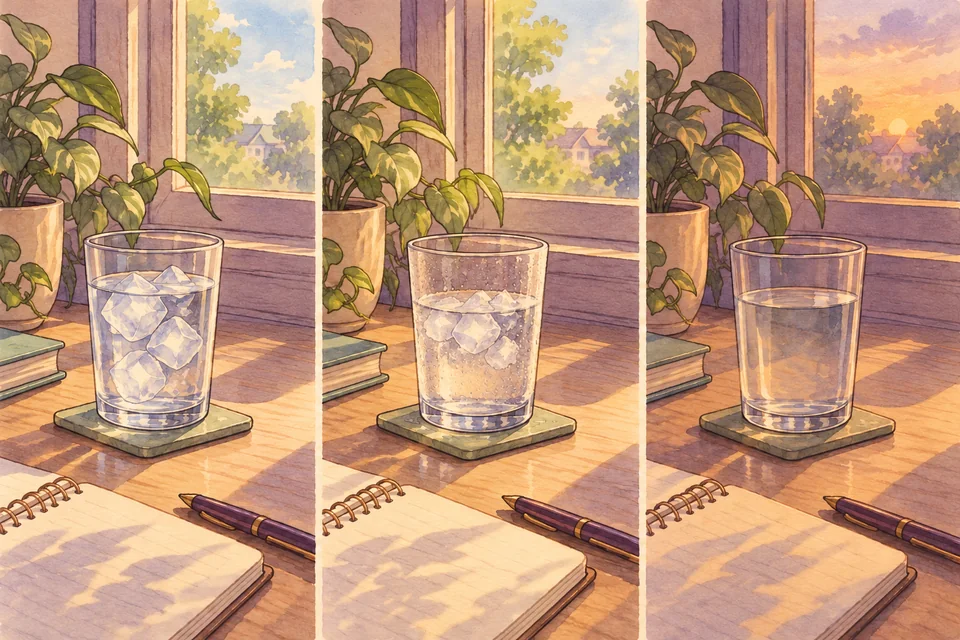
Set a glass of cold water on a table. The ice slowly melts, more drops gather on the outside, and the water grows warmer. You know the glass is different from when you first set it down, even without looking at a clock.
When I say that time does not really exist, I mean that I understand what we call time through changes in things around and within us, such as warming water or a shifting feeling. This is a way I think about life, not a conclusion about physics.
That thought brings to mind the three characteristics of existence in Buddhism, and makes me want to ask how we live with change.
What we notice is change
We can tell today from yesterday because something has changed. The light outside the window is different. Our bodies feel more tired or refreshed. A message that had no reply now has one. These differences let us talk about before and after.
Clocks help us keep appointments and compare intervals on a shared scale. I still see their full practical value. But beyond the numbers on the dial, what interests me is what changed between those points.
When anger begins to fade, we are describing a feeling different from the one we first had. When something seems less important than it once did, perhaps the information we have or what we want has changed too. We notice differences both around us and within ourselves.
I look at this change through anicca, or impermanence. Instead of stopping at a count of the days that have passed, I also want to ask what conditions allow something to remain as it is.
Anicca: What depends on conditions does not stay the same
Anicca describes the impermanence of conditioned things, things that arise depending on causes and conditions. Verse 277 of the Dhammapada says that all conditioned things are impermanent. Something that appears stable for a while is not therefore guaranteed to stay that way forever.
Feelings offer a place to observe this. We may feel differently about something after learning more. Remembering how much we liked it once and liking it now can be two different things. The memory can hold the old picture even when the feeling has changed.
As I understand it, impermanence does not mean that everything changes quickly. Some differences appear at once; others take longer to notice. What interests me is how much we expect things to stay the same, especially things we want to keep.
Dukkha: The difficulty of keeping things as they are
In the three characteristics, dukkha means more than felt pain. It points to the inability of conditioned things to remain a permanent, dependable refuge, or the difficulty of holding them in one state as their conditions change.
Sutta SN 36.11 discusses pleasant, painful, and neither-pleasant-nor-painful feelings. It connects the statement that feelings fall under dukkha with the impermanence and change of conditioned things. A happy moment can still be happy. We simply cannot order it to remain exactly as it is forever.
Another difficulty may arise when a feeling changes but we still want to return to the moment when we were content. We may say we want to stop time, when what we really want to keep is a person, a situation, or the feeling we had then.
For me, seeing what I want to preserve brings the question of time closer to daily life. Regret may begin in the gap between what is here and the picture we want to be true. That picture deserves a close look too.
Anatta: Even what we call ourselves is not entirely under our command
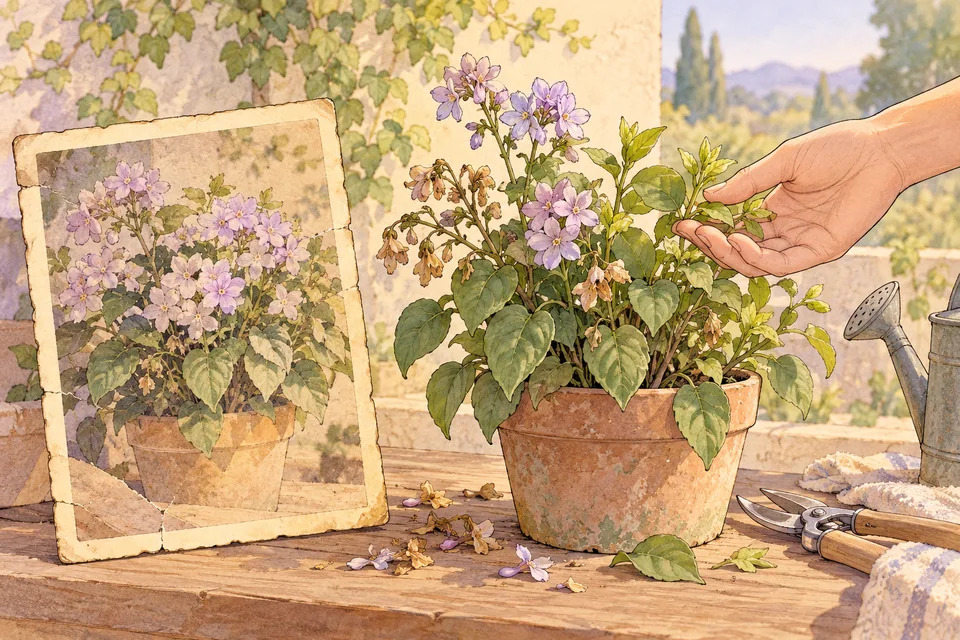
As I understand it, anatta invites us to see that there is nothing we can permanently hold as ourselves or ours. Things arise and pass away depending on conditions. They come into being and change. Wanting them to stay the same does not give us the power to keep them that way.
That arising and passing away reminds me of anicca. Anatta takes the question further: Should we cling to what changes, and what we cannot command to remain, as "me" or "mine"?
In the Anattalakkhana Sutta, the Buddha considers form, feeling, perception, mental formations, and consciousness. He points out that we cannot command all of these to be as we wish, and invites us to consider them without clinging to them as a self.
One Pali passage reads "netaṃ mama nesohamasmi na meso attā." The Thai Royal Edition translates it as "That is not mine. That is not me. That is not my self." See the Pali Tipitaka, volume 4, item 22 and the Thai Tipitaka, Royal Edition, volume 4, item 22 in the Vinaya Pitaka, Mahavagga, part 1.
I understand the absence of anything to cling to as a way to loosen our grip on "me" and "mine." We can still choose to care for our bodies and change some of the conditions around us. We cannot command our bodies or feelings to remain the same forever. Effort still matters, even when the outcome is not entirely ours to control.
How, then, do I look at what has changed?
When I say something "isn't the same anymore," I want to look closer than simply saying that time changed it. There may be new information, different wants, or conditions that no longer match the old ones. Seeing those details gives me a place to begin thinking about what I can care for or adjust.
Some things may still be kept through attention. Others must be allowed to change with the conditions around them. I still value taking action, even when I cannot preserve everything as it was. Thinking about time this way brings me back to what is happening now and what I can choose to do with it.
Think of one thing you've called "not the same anymore." Did the event in front of you change, did your feeling change, or did your expectation of it change?
Questions about time and the three characteristics
Do the three characteristics prove that time does not exist?
I do not use the three characteristics as proof about time. I use them to consider impermanence, the difficulty of keeping things in one state, and clinging. The idea about time is my personal view.
Does this view make appointments meaningless?
Clocks still help us keep appointments and compare intervals on a shared scale. I still see their value. The question in this article is what we notice between those points.
Source note: The view of time is my own. I checked the meanings of the three characteristics against English translations of Dhammapada verses 277-279, Anattalakkhana Sutta, SN 22.59, and Rahogata Sutta, SN 36.11 published at dhammatalks.org. The Pali passage and Thai translation in the anatta section refer to the Vinaya Pitaka, Mahavagga, part 1, volume 4, items 20-24, using the Thai Royal Edition translation.