

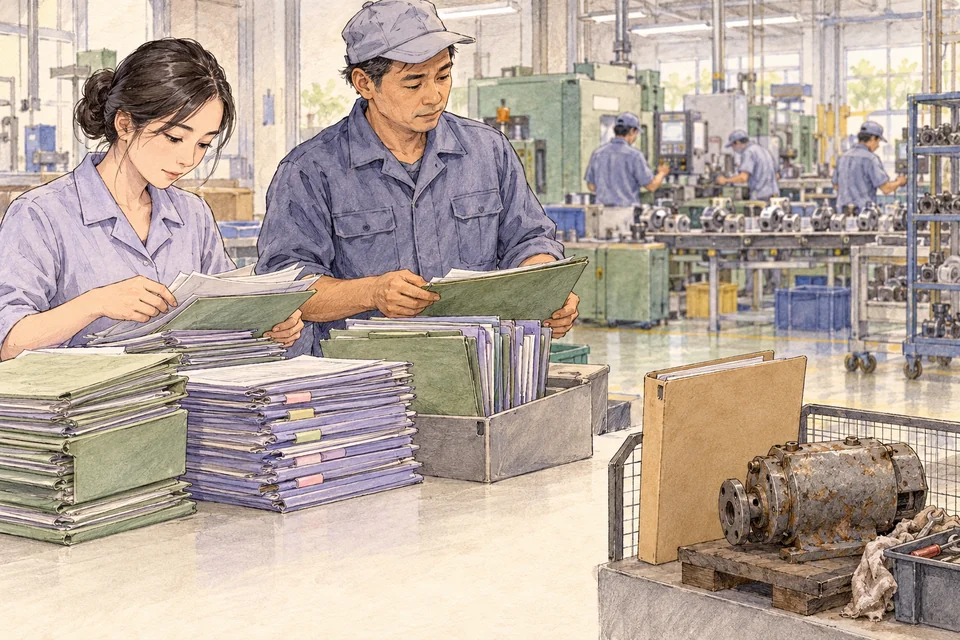
The cover depicts a hypothetical factory, not a real business or financial records.
A factory has THB 20 million in sales and THB 2.3 million in earnings before interest and tax. That does not tell us whether it can earn as much next year. If this year's results include a gain from selling a machine, the cost of closing a production line, and an impairment loss on a remaining machine, I would separate those items before applying a multiple to earnings.
The factory and every figure in this "From Revenue to Company Value" series are hypothetical examples for explaining the analysis. They are not financial statements of my business or a client. This article establishes an earnings base. The next articles connect revenue recognition, cash, and valuation methods. Every step should lead back to evidence for its numbers.
Reading earnings quality means asking where profit came from, how likely it is to recur, and what resources are needed to sustain it. Adjusted earnings for analysis are not a replacement set of financial statements, nor a promise that an excluded item will never recur. An analyst must explain each adjustment and its effect on cash.
Revenue, profit, and earning power are different measures
Revenue records the value recognized from activities under accounting rules. Profit is what remains after the related revenue and expenses are measured under the business's reporting framework. Strong sales may leave little profit when delivery costs are high, rework is needed, or customers are hard to collect from.
Accounting profit uses accruals and estimates, so it differs from cash received and paid. Sustainable earning power is an analyst's estimate of normal business performance, not a fixed number known in advance. Economic income also considers returns and changes in the value of future benefits. It should not simply replace net income or comprehensive income in the statements.
A company with rising profit may also be taking more risk, for example by giving customers longer credit or depending on one buyer. Value therefore does not rise in a fixed proportion to earnings. We also have to examine growth, the investment needed to support it, and the risk around future cash.
Use two dimensions before deciding what belongs in the earnings base
| Type of item | Likely to recur | May not recur in the same form |
|---|---|---|
| Related to operations | Profit from selling parts, ordinary labor costs, and routine maintenance costs | Cost of closing a production line or damage to an operating asset |
| Outside the core business being valued | Interest on excess cash held on deposit over time | Gain on selling an investment not used in operations |
An item can recur without being core operating profit. An operating cost need not be the same every year either. Define the business being valued. Interest may be peripheral for a factory but central to a financial business.
Consider restructuring costs that arise nearly every year. If a company repeatedly changes plans, reduces staff, or migrates systems, excluding each charge makes the earnings base look better while leaving no budget for work the business actually does. Calling an item "special" is not enough reason to add it back.
Connect reported profit to the base used for analysis
Return to the hypothetical factory. In the base year it sells THB 20 million, with THB 12 million in cost of goods sold and THB 4 million in operating expenses. Neither amount includes the THB 1 million of depreciation and amortization shown separately; operating expenses do include expected warranty costs. Before the additional items, the business therefore earns THB 3 million. This year it also incurs THB 0.5 million to close a production line and a THB 0.8 million machine impairment, while gaining THB 0.6 million from selling an old machine. Earnings before interest and tax at the start of the analysis are thus THB 2.3 million.
The THB 2.3 million is a starting base before separating these items. It is not necessarily the line called "operating profit" in every company's statement format. The adjustments below estimate earnings from continuing operations for analysis; they do not instruct anyone to change the original accounts.
| Item | Increase or decrease | Reason and what must still be reflected |
|---|---|---|
| Earnings before interest and tax at the start of the analysis | 2.30 | Includes the items above; not yet a verified normal earnings figure |
| Cost of closing a production line | +0.50 | Assume closure and payment are complete in the base year, it will not recur, and the closed line's revenue and costs have also been removed from future plans. |
| Machine impairment loss | +0.80 | Remove this charge to examine operating earnings, while retaining the lower capacity and demand assumptions in the forecast. Adding it back does not restore asset value or sales. |
| Gain on selling an old machine | −0.60 | Exclude it from earnings expected from continuing production. The sold machine and its future cash flows have been removed from the relevant base. |
| Operating earnings adjusted for analysis | 3.00 | A result under the stated assumptions; revise it if evidence about recurrence or future operations changes. |
Such adjustments require a view of ordinary operations and the costs of sustaining profit, not a selection of items that only improve the answer. For more on normalized earnings, see Aswath Damodaran on normalized earnings. The table's figures are a new example for this article, not figures from that source.
See how adjusted earnings are derived
- 1 Earnings before interest and tax before analytical adjustments: 2.30
- 2 Add production-line closure cost: 0.50
- 3 Add impairment loss: 0.80
- 4 Subtract asset-sale gain: 0.60
- 5 Adjusted operating EBIT: 3.00
Examine documents, reasons, and several years of history
Retain necessary operating costs and future effects
Track outstanding obligations even if an expense is removed from the earnings base
Read accounting notes through to the underlying event
Impairment calls for particular care. For assets within TAS 36, compare carrying amount with recoverable amount, which is the higher of fair value less costs of disposal and value in use. A market price below book value alone does not settle the question. Inventory and credit losses have separate requirements. [TAS 36]
If customers no longer want the product made by an impaired machine, a valuation must also lower future expectations. We cannot add back the expense while keeping the old sales forecast. In this example, we assume the activity forecast has been revised and do not write the remaining machine back up to reverse this impairment.
A restructuring provision cannot be created solely from a management budget. The facts and obligation must meet the requirements. Expected future operating losses do not automatically justify a provision. [TAS 37] If cash still has to be paid later, keep it in the relevant cash-flow forecast or liability, without counting it twice.
Changes in accounting policies, changes in estimates, and prior-period errors are reflected differently in the statements. Check whether comparative figures have already been restated and whether the event changed the business's economics or only its measurement. A change in a number alone is not proof of earnings management. [TAS 8]
Ending an activity does not automatically make it a "discontinued operation" under TFRS 5. Check the criteria for that component first, and compare the remaining activities on a consistent basis. [TFRS 5]
Do not read net income and ignore the rest of the statements
Other comprehensive income (OCI) may reflect changes in equity outside net income, such as some foreign-operation translation differences. Read it under the applicable standard. Not every unrealized gain is OCI, and an OCI amount is not cash ready to distribute to shareholders.
Financial statements prepared under TAS 1 do not present income or expense as "extraordinary items." An analyst may still separate unusual or nonrecurring events to understand them. Preparing the statements and building an analytical bridge are different jobs. [TAS 1]
How does this apply to systems integrators and factories?
For a systems integration (SI) business working with enterprise resource planning (ERP), I would first separate earnings by type of work: project development, ongoing support, and resale of others' software rights or services. Then I would examine rework hours, key staff costs, renewals, and revenue-recognition evidence. Revenue that appears recurring may require a new sale each year or depend on one person.
If an owner manages and works in the business for low pay, valuing a company that must continue without that owner calls for a reasonable replacement cost. Do not add back all owner expenses and assume the work will be done for free. Software-development costs require attention to both accounting policy and future cash investment. A high gross margin is not evidence that almost no capital is needed.
In a factory, I would connect profit with capacity use, waste, maintenance, and slow-moving inventory. If profit looks good because repairs are deferred or production is pushed into inventory, ask how much cash or future obligation supports it. Those indicators call for questions; they are not proof of fraud by themselves.
Before applying a valuation multiple to earnings, ask for each proposed adjustment, its evidence, and its future effect. If we cannot say which costs remain, who will do the work, and how much cash is still owed, I would not rely on a single "normal earnings" number.
Accounting standards were checked on October 18, 2026, against the versions relevant to the reporting period. The figures and proposals are illustrative, not a valuation of any company. The applicable reporting framework and actual accounting conclusions must be checked with those responsible for the business.